Struggling with Digital Marketing for your Tourism Business?
Why Tourism Businesses Need Campaigns, Not Random Marketing Tasks
Tourism businesses need campaigns because isolated posts, adverts and SEO tasks do not create a reliable path from discovery to enquiry. A structured
tourism digital marketing strategy connects the offer, audience, message, traffic source, landing page, follow-up and tracking into one system designed to generate qualified leads.
Key Takeaways
- A collection of marketing tasks is not the same as a campaign.
- Every campaign needs one audience, one offer and one measurable objective.
- SEO, content, paid ads, landing pages and email should support the same customer journey.
- Campaign tracking shows which activities contribute to enquiries and sales.
- Tourism lead generation improves when the message, traffic source and landing page match.
- A specialist tourism marketing agency can coordinate the full system instead of managing disconnected channels.
Why Random Posts and Occasional SEO Do Not Work
Many tourism businesses are doing plenty of marketing.
They post on social media. They occasionally write a blog. They boost a Facebook post. They send a newsletter when there is a special. They update a page on their website and perhaps run Google Ads for a few weeks.
The business is busy, but the marketing is not necessarily moving anyone towards an enquiry.
This happens because the individual tasks were never designed to work together.
A social post may promote one message while the website leads with another. A paid advert may send visitors to a general homepage. An SEO article may attract people researching a destination without giving them a relevant next step. An email may promote an offer that has no dedicated landing page.
Each activity can produce impressions, traffic or engagement. That does not mean it is creating commercial momentum.
Random marketing usually fails for five reasons:
- There is no defined campaign objective.
- The audience is too broad.
- The offer is unclear or generic.
- The customer journey ends after the first click.
- Results are measured by activity rather than business outcomes.
Publishing more content will not fix a disconnected strategy. Running more ads will not fix a weak offer. Increasing website traffic will not help when visitors cannot quickly understand what is being offered, whether it suits them and what they should do next.
A tourism business does not need more unrelated marketing tasks. It needs a coordinated campaign with a clear commercial purpose.
What a Tourism Marketing Campaign Actually Includes
A tourism marketing campaign is a coordinated set of activities created around a specific audience, offer, objective and period.
It is not simply a series of posts on the same topic.
A complete marketing campaign for a tourism business should answer seven questions:
- Who are we trying to reach?
- What does that audience want?
- What specific offer are we presenting?
- Why should they choose this business?
- Where will we reach them?
- What action should they take?
- How will we measure the result?
The campaign may promote:
- A seasonal lodge offer
- A private safari
- A family travel package
- A photographic tour
- A destination itinerary
- A new tourism experience
- A lead magnet or travel guide
- A direct-booking benefit
- A trade partnership opportunity
- A quieter travel period
- A specific room, route, departure or experience
The structure should then connect the campaign components.
Audience Research
The business first needs to understand the people most likely to buy the offer.
“International travellers” is not a useful campaign audience.
A stronger audience definition could be:
- South African couples looking for a short luxury bush escape
- European families planning their first private safari
- Experienced wildlife photographers comparing small-group departures
- Travel agents looking for bookable African products
- Repeat safari travellers interested in walking and conservation
- Remote workers looking for longer, quieter stays
Different audiences have different concerns, budgets, booking periods and decision-making processes.
The campaign must be built around those differences.
A Specific Offer
A tourism campaign needs something concrete to promote.
“Visit our lodge” is not a campaign.
“Stay three nights during the quieter summer period and include a private guided experience” is much closer to one.
The offer does not always need to include a discount. It can be built around:
- Added value
- Exclusivity
- Convenience
- Limited availability
- A specialised interest
- A defined departure
- A particular season
- A clear guest type
- A specific problem the experience solves
The offer gives the marketing a centre. Without it, the content becomes generic and the call to action becomes weak.
Campaign Messaging
The campaign message explains why the offer matters to that particular audience.
A family, honeymoon couple, photographer and travel agent may all be interested in the same destination, but they will not respond to the same message.
Strong tourism campaign messaging addresses:
- What the traveller wants
- What may be making the decision difficult
- How the offer solves that problem
- What makes the experience different
- What happens after the traveller enquires
- Why there is a reason to act now
The message should remain consistent across adverts, articles, emails and landing pages. The wording may change between platforms, but the central promise should not.
How to Connect Content, Ads, Landing Pages, and Email
A tourism digital marketing strategy works when every channel has a defined role.
The traveller should be able to move from first awareness to enquiry without encountering conflicting messages or unnecessary dead ends.
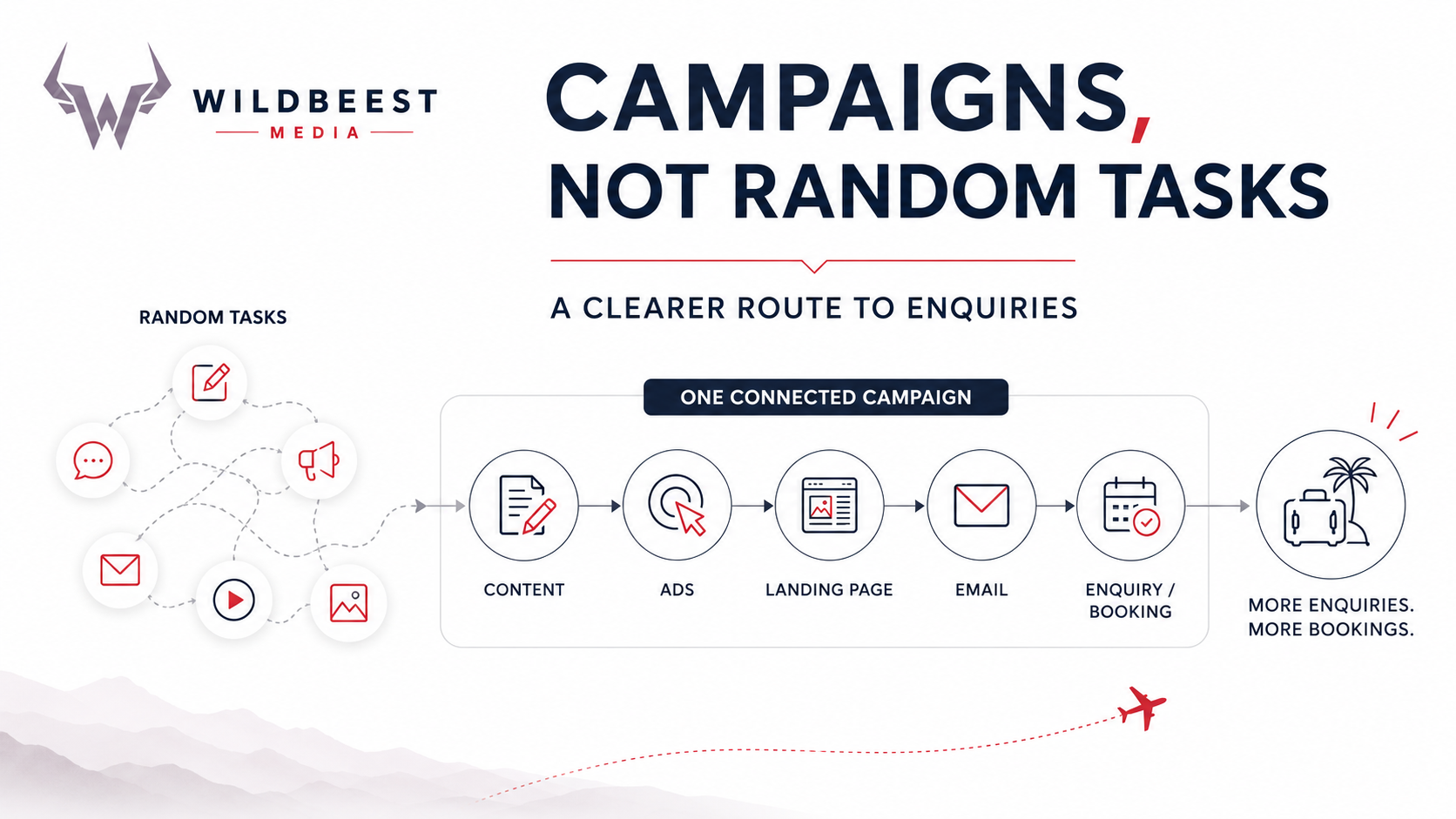
A simple campaign journey may look like this:
Traveller → Content or Advert → Landing Page → Lead or Enquiry → Email Follow-Up → Consultation or Booking
Each part supports the next.
Content Creates Discovery and Trust
Content helps the business answer the questions travellers ask while researching and comparing their options.
This may include:
- SEO articles
- Destination guides
- Experience comparisons
- Planning advice
- Press releases
- Case studies
- Videos
- Social media posts
- Downloadable itineraries
The objective is not to publish content simply because the content calendar says something is due.
Content should attract a relevant audience, build confidence and direct the reader towards a campaign action.
For example, an article about planning a first safari could lead to a downloadable safari-planning guide. The guide could introduce a suitable itinerary. The follow-up emails could then answer common questions and invite the traveller to request a proposal.
That is a campaign.
Publishing the article and waiting for enquiries is not.
SEO Captures Existing Demand
Tourism SEO helps a business appear when potential travellers are actively researching a destination, experience or problem.
SEO can attract people searching for:
- Where to stay
- What to do
- Which experience to choose
- When to travel
- How much a trip may cost
- What is included
- How two destinations or products compare
- Which operator, lodge or itinerary suits them
However, ranking a page is only the beginning.
The page must also connect the search question to a relevant offer and next step. Otherwise, the business may gain traffic without improving tourism lead generation.
Paid Advertising Accelerates Reach
Paid ads for tourism can place the campaign in front of relevant people faster than organic marketing alone.
Google Ads can reach people already searching for a product, destination or experience.
Meta Ads can introduce the offer, build demand, retarget previous visitors and reconnect with people who showed interest but did not enquire.
The advert should not operate as a standalone piece of marketing.
It must match:
- The audience
- The campaign offer
- The landing-page message
- The visual presentation
- The call to action
- The next stage of the journey
An attractive advert cannot compensate for a confusing landing page.
Landing Pages Convert Attention into Action
A campaign should normally send traffic to a focused landing page rather than a general homepage.
The landing page should answer the visitor’s immediate questions:
- What is being offered?
- Is it suitable for me?
- Where does it take place?
- What is included?
- What makes it different?
- What should I do next?
- What happens after I submit the form?
The page should remove irrelevant navigation and competing messages where appropriate.
It should also include a clear conversion point, such as:
- Request an itinerary
- Check availability
- Download a guide
- Ask for a quote
- Book a consultation
- Join a priority list
- Submit a trade enquiry
A campaign landing page gives the traveller a direct route forward.
Email Continues the Conversation
Most travellers do not make a high-value booking immediately after seeing one advert or reading one article.
They compare dates, prices, destinations, inclusions, flights, reviews and alternative providers. They may also need to consult a partner, family member or travel companion.
Email allows the tourism business to remain part of that decision.
Campaign emails can:
- Deliver a requested guide or itinerary
- Explain the offer in more detail
- Answer common objections
- Introduce the people behind the experience
- Share useful planning information
- Present reviews or past traveller experiences
- Remind the reader about availability
- Invite a direct conversation
Email marketing is particularly valuable for premium and considered travel purchases because it allows trust to develop over time.
The goal is not to send constant sales messages. It is to give interested travellers useful reasons to keep moving towards a decision.
Why Campaigns Make Tracking Easier
Random marketing creates random data.
The business may know how many people liked a post, opened an email or visited the website, but it cannot explain which activities contributed to meaningful enquiries.
A structured campaign makes measurement more practical because every activity shares a defined objective.
Campaign tracking may include:
- Landing-page visits
- Cost per landing-page view
- Guide or itinerary downloads
- Form submissions
- Calls or WhatsApp enquiries
- Cost per lead
- Qualified enquiries
- Consultation bookings
- Proposal requests
- Confirmed bookings
- Revenue generated
- Return on advertising spend
- Email engagement
- Assisted conversions
- Conversion rate by audience, advert or landing page
Not every enquiry is equally valuable.
A campaign that generates 50 poor-fit leads may be less effective than one that generates ten enquiries from people with the correct budget, dates and travel requirements.
That is why tourism campaign performance should not be judged only by volume.
The business must also evaluate:
- Lead quality
- Commercial value
- Booking likelihood
- Average booking value
- Sales follow-up
- Time to conversion
- Reasons enquiries do not proceed
Campaign data creates a feedback loop.
The tourism business can identify which audience responds, which message attracts attention, which page converts and where potential travellers leave the journey.
The next campaign can then be improved based on evidence rather than assumption.
How Campaign Building Helps Tourism Brands Grow
Campaign building gives a tourism business more than a temporary promotion.
It creates a repeatable growth process.
Campaigns Create Focus
Instead of attempting to market every room, itinerary, departure and experience at once, the business can prioritise one commercial opportunity.
That opportunity may be based on:
- Seasonal demand
- Low occupancy
- A new departure
- A profitable product
- A priority international market
- A particular traveller segment
- A new route or experience
- Available inventory
- A direct-booking objective
Clear focus improves the message and makes budget allocation more deliberate.
Campaigns Improve Enquiry Quality
A well-built campaign tells the audience exactly who the offer is for.
This allows unsuitable prospects to opt out before enquiring and gives suitable prospects more confidence to proceed.
The business receives fewer vague questions and more informed enquiries.
That matters when the sales team spends significant time building customised itineraries, preparing proposals or responding to detailed requests.
Campaigns Build Reusable Assets
A strong campaign can produce assets that remain useful after the initial promotion ends.
These may include:
- Search-optimised articles
- Landing-page structures
- Audience research
- Email sequences
- Advert audiences
- Conversion data
- Traveller FAQs
- Lead magnets
- Photography and video
- Retargeting audiences
- Sales insights
The campaign becomes part of the business’s long-term marketing infrastructure.
Campaigns Reduce Guesswork
Campaign planning replaces “What should we post this week?” with more useful questions:
- Which product needs support?
- Which audience is most relevant?
- What problem are they trying to solve?
- What information do they need before enquiring?
- Where are they likely to discover the offer?
- What should happen after they click?
- How will the sales team follow up?
- Which result will determine whether the campaign worked?
That is a much stronger foundation for growth than producing more content without a clear commercial direction.
Campaigns Connect Marketing and Sales
Marketing does not end when a form is submitted.
The quality and speed of the response, the proposal process, the availability information and the follow-up all influence whether an enquiry becomes a booking.
A complete campaign therefore considers what happens after lead generation.
This may include:
- Enquiry notifications
- Lead qualification
- Automated acknowledgements
- Response templates
- Consultation scheduling
- Proposal follow-up
- Email nurturing
- Retargeting
- Lost-lead analysis
The strongest campaign cannot compensate for an enquiry that receives no response for several days. Marketing and sales must support the same journey.
Tourism Marketing Requires a Connected System
Tourism businesses often approach agencies or freelancers with a list of tasks:
- Run our social media.
- Improve our SEO.
- Start Google Ads.
- Build a landing page.
- Send a newsletter.
- Write a blog.
- Redesign the website.
Each task may be useful. The problem is starting with the channel instead of the campaign.
Before deciding what to produce, the business should define:
- The commercial objective
- The priority audience
- The offer
- The campaign message
- The customer journey
- The required channels
- The conversion action
- The follow-up process
- The measurement framework
Only then should the business decide whether it needs SEO, Meta Ads, Google Ads, email, content, digital PR, a landing page or a website change.
The channel is a delivery mechanism.
The campaign is the strategy.
Working With a Tourism Marketing Agency
A specialist tourism marketing agency should do more than complete a monthly task list.
It should understand how travellers research, compare and purchase tourism experiences. It should also understand the operational realities behind availability, seasonality, rates, distribution, trade relationships, long decision periods and high-value enquiries.
At WildBeest Media, we build end-to-end tourism marketing campaigns around the full journey.
Depending on the campaign, this may include:
- Customer and competitor research
- Traveller persona development
- Offer and campaign shaping
- Tourism SEO
- Website content
- Press releases and off-page articles
- Google Ads
- Meta Ads
- Campaign landing pages
- Lead magnets
- Email marketing
- Website development
- Conversion tracking
- Monthly performance analysis
These are not sold as disconnected answers to disconnected problems. They are selected and coordinated according to what the tourism business is trying to achieve. The objective is not to keep the marketing department busy. The objective is to build a clearer route from attention to enquiry.
Stop Guessing. Build a Campaign That Has Somewhere to Go.
Posting more frequently is not a strategy. Running an advert is not a complete campaign. Increasing traffic is not enough when there is no clear route from interest to enquiry.
WildBeest Media connects the offer, audience, content, SEO, paid advertising, landing pages, email and tracking into a structured tourism digital marketing strategy.
Stop guessing. Let WildBeest Media build a structured campaign for your tourism business.
Frequently Asked Questions
What is a tourism marketing campaign?
A tourism marketing campaign is a coordinated set of marketing activities built around a specific audience, offer, objective and period. It may combine content, SEO, paid advertising, landing pages, email, social media, digital PR and sales follow-up to guide potential travellers from discovery to enquiry or booking.
Why is my tourism marketing not working?
Tourism marketing often underperforms when the audience is too broad, the offer is unclear, the channels are disconnected or the website does not provide a clear next step. It may also fail because the business measures reach and traffic without tracking qualified enquiries, proposals and bookings.
How do I create a campaign for a tourism business?
Start by choosing one commercial objective and one priority audience. Develop a relevant offer, identify the audience’s questions and objections, create a clear campaign message and map the journey from first contact to enquiry. Then select the content, advertising, landing pages, emails and tracking needed to support that journey.
What should be included in a tourism marketing campaign?
A tourism marketing campaign should include a defined objective, audience research, a specific offer, clear messaging, relevant content, suitable traffic channels, a focused landing page, a conversion action, follow-up communication and performance tracking. The exact channel mix should be determined by the campaign rather than selected in isolation.
How do I measure campaign success?
Measure campaign success against its original commercial objective. Useful metrics may include qualified leads, enquiry conversion rate, cost per lead, proposal requests, confirmed bookings, booking value, return on advertising spend and revenue. Traffic, impressions and engagement can provide supporting information, but they should not be treated as the final result
No obligations - just honest advice to cut through the BS.
Feeling Overwhelmed?
Let's Work Together
Downloads
Share The Tips