Struggling with Digital Marketing for your Tourism Business?
How to Use ChatGPT for Tourism Marketing Without Sounding Generic
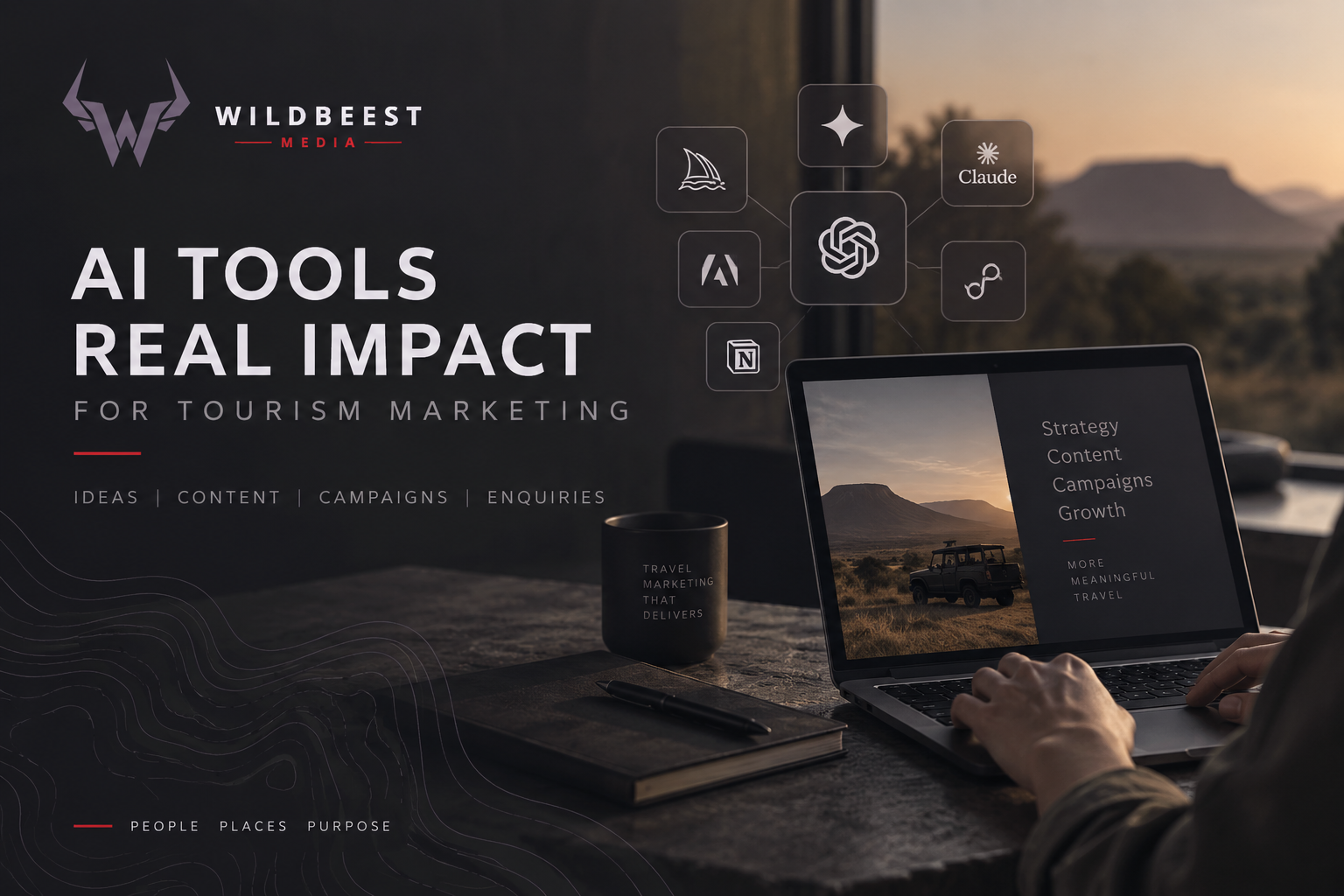
ChatGPT works best for tourism marketing when it is given real product information, a defined audience and clear brand instructions. At
WildBeest Media, we use AI as part of a wider
tourism digital marketing process, while our
growth strategy focuses on connecting that work to enquiries and commercial goals.
Key Takeaways
- ChatGPT produces stronger marketing when it works from verified business information rather than a blank prompt.
- Generic AI content usually comes from weak briefs, limited source material and unclear positioning.
- ChatGPT Projects can keep reference files, instructions and related conversations together for recurring marketing work.
- Human review remains necessary for factual accuracy, brand positioning and the final decision to publish.
How to Use ChatGPT for Tourism Marketing
The most useful role for ChatGPT in tourism marketing is as a research, planning and production assistant. It can help organise information, analyse customer feedback, develop campaign ideas, draft content, compare messaging and repurpose existing material, but the quality of that work depends on the information it receives.
Tourism marketing is particularly sensitive to missing context because travellers compare specific products, not generic categories. Accommodation businesses may differ in location, room configuration, access, activities or who they are suitable for. Tours may differ in itinerary structure, inclusions, group format or the amount of time allocated to an experience. If ChatGPT does not have those details, it cannot communicate them accurately.
The better approach is to supply the material your business already uses. Product information, itineraries, frequently asked questions, customer enquiries, reviews, audience information, website copy and approved marketing material can all provide useful context. ChatGPT supports uploaded documents, spreadsheets and other common file types, which means it can work from existing business information rather than having to invent context.
This makes ChatGPT more useful for practical marketing work. A tourism business can review a set of enquiries to find recurring questions, analyse reviews for repeated themes or use existing product information to identify gaps in website content. The objective is not simply to generate more copy; it is to make better use of information the business already has.
Our guide to ChatGPT prompts for tourism content creation covers the prompting side in more detail. The important point is that a good prompt cannot compensate for missing product information or an unclear marketing objective.
Why AI Marketing Content Often Sounds Generic
AI marketing content usually sounds generic because the brief is generic.
A prompt such as “write an Instagram post about our safari lodge” gives ChatGPT almost no information about the audience, product, purpose or positioning. The result may be grammatically correct, but there is little reason for it to sound different from content created for another lodge.
This is a common problem in tourism because the industry already uses a lot of repeated language. Terms such as luxury, authentic, immersive and unforgettable are often used without explaining what the traveller can actually expect. AI can make that problem worse when it is asked to fill gaps instead of working from verified information.
A stronger brief gives ChatGPT something specific to communicate. Rather than asking it to promote “a luxury stay”, provide the actual product information and ask it to explain who the experience is suitable for, what makes it different from alternatives and which questions the content needs to answer.
The same principle applies to SEO content. Asking ChatGPT to produce an article around a keyword without real expertise, source material or a clear search intent often creates another version of information already available elsewhere.
Google's current guidance is clear that generative AI can be useful for research and structure, but using it to create large volumes of content without adding value may conflict with its spam policies. Google continues to emphasise accuracy, quality, relevance and useful, original content rather than rewarding content simply because AI was or was not involved.
For a tourism business, the most useful source of originality is often its own operational knowledge. Customer questions, sales conversations, destination knowledge, product details and first-hand experience provide material that competitors cannot reproduce simply by using the same AI tool.
This is why ChatGPT should sit inside a broader marketing process. The same principle applies when choosing a tourism marketing agency: the value comes from the strategy and understanding behind the work, not simply access to tools.
Training ChatGPT on Your Brand Voice and Tourism Product
When marketers refer to “training ChatGPT on a brand”, they usually mean giving it consistent working context rather than retraining the underlying model.
A dedicated ChatGPT Project is one practical way to do this. Projects keep related conversations, uploaded files and project-specific instructions together, allowing recurring work to use the same reference material and rules. OpenAI specifically positions Projects for repeated workflows such as writing, research and planning.
For tourism marketing, useful reference material may include brand guidelines, product information, FAQs, itineraries, audience notes, approved website copy and examples of previous content that correctly represents the brand.
The instructions should then explain how that material must be used. That could cover tone, spelling, preferred terminology, words to avoid, how factual information should be handled and what ChatGPT should do when information is missing.
One of the most useful instructions is also one of the simplest:
Do not invent product information. If a required fact is not available in the supplied material, identify the gap rather than filling it in.
That matters because factual accuracy in tourism content can affect a real booking decision. If AI invents an inclusion, facility, travel detail or policy, the problem is not just stylistic.
Brand voice also needs more than a few adjectives. Telling ChatGPT to sound “warm, authentic and professional” leaves considerable room for interpretation. Approved examples are more useful because they show how the brand actually communicates.
A small collection of articles, newsletters or social posts that already sound right gives ChatGPT a stronger reference than a generic tone description.
The Practical Answer: Give ChatGPT Context Before You Give It a Task
The most reliable way to use ChatGPT for tourism marketing without sounding generic is to give it specific business context before asking it to produce anything.
That context should explain the product, audience, objective, source material and brand rules. The prompt should then define the task and any factual limits. ChatGPT can help organise, draft and improve the material, but the business should still review whether the final output is accurate, useful and commercially relevant.
In practical terms, the process is:
Verified business information → clear marketing objective → specific prompt → ChatGPT-assisted output → human review
This approach is more reliable than trying to fix generic content afterwards with instructions such as “make this sound more human”.
Better ChatGPT Prompts for Marketing Content
Good ChatGPT prompts for marketing do not need to be long, but they do need to be specific.
A useful prompt normally gives ChatGPT five things: the context, the audience, the source material, the required task and the constraints.
A weak prompt might be: Write a Facebook ad for our lodge.
A stronger version would be: Using only the lodge information and approved customer feedback provided in this Project, develop three Meta ad concepts for the audience described in the brief. Each concept should use a different advertising angle and include primary text, a headline and a clear call to action. Do not invent facilities, inclusions or product details.
The stronger version does not depend on clever wording. It works because ChatGPT knows what information it may use and what job it needs to perform.
For SEO, the same principle applies. Do not ask ChatGPT to manufacture keyword data. Use real information from Search Console, SEO source, then ask ChatGPT to help classify search intent, organise themes, identify content gaps or turn the findings into an article brief.
For email marketing, include the customer stage and the purpose of the email. An enquiry follow-up, previous-customer campaign and trade communication require different messages because they serve different parts of the sales process.
For social media, work from a real source rather than asking ChatGPT to invent a month of content. An existing article, product update, customer question or campaign can be adapted into several platform-specific pieces without creating filler.
For research that depends on current information, ChatGPT can use web search inside supported experiences, including within Projects. The final information should still be checked before it becomes published marketing material.
The quality of ChatGPT prompts for marketing therefore depends less on prompt tricks and more on the quality of the brief.
Building a Human and AI Content Creation Workflow
A useful AI content marketing workflow assigns repetitive and analytical work to ChatGPT while keeping strategic and factual decisions with people.
A practical workflow can look like this:
Source material → research → marketing decision → ChatGPT-assisted drafting → human review → publishing → performance analysis
ChatGPT can help with several stages. It can organise customer questions, compare content, structure an article, create variations and analyse exported data. The business still needs to decide what matters, whether the information is correct and whether the finished content represents the brand properly.
That division is important for SEO as well. Google does not say that content becomes unsuitable simply because AI was involved. Its guidance focuses on whether the content is accurate, useful, original and created to help users rather than simply to manipulate search rankings.
Google's 2026 guidance for generative AI search also confirms that established SEO practices remain relevant. It places additional emphasis on useful, unique and non-commodity content that gives search systems something valuable to retrieve and reference.
For tourism businesses, that strengthens the case for combining AI with real expertise rather than replacing expertise with AI. Your product knowledge, customer insight and understanding of the destination are the valuable inputs. ChatGPT can help organise and communicate them more efficiently.
That is also the approach behind our wider article on AI and tourism marketing: AI should improve the marketing process without removing the real information and perspective that make a tourism business distinct.
Build Faster Content Without Losing What Makes Your Tourism Brand Different
ChatGPT can reduce the time spent on research, drafting and repurposing, but it delivers better marketing when the business first has clear positioning, accurate product information and a defined commercial objective.
At
WildBeest Media, we help tourism businesses connect AI with SEO, content, advertising, websites and lead generation rather than treating AI as a standalone marketing strategy. If you want to build that into a more structured system, start with our free
three-month tourism growth strategy.
Frequently Asked Questions
Can I upload my brand guidelines to ChatGPT?
Yes. ChatGPT supports common document, spreadsheet and presentation file types, so brand guidelines can be added as reference material.
For recurring marketing work, keeping those guidelines inside a dedicated Project can be more practical because the Project can also contain related files, conversations and instructions.
Can ChatGPT learn about my business from my website?
ChatGPT can use current web information when web search is available, but that is different from permanently learning the complete contents of a business website.
For ongoing marketing work, important product and brand information should be supplied directly in the relevant conversation or Project rather than assuming it will be reconstructed correctly each time.
Should I create a separate ChatGPT project for my business?
For ongoing marketing work, it can be useful. Projects are designed to keep chats, reference files and custom instructions together, which makes them suitable for recurring content, research and planning workflows.
Businesses managing more than one brand should keep each brand's source material and instructions clearly separated.
Do businesses need to disclose when marketing content was written with AI?
There is no single global rule requiring every piece of AI-assisted marketing content to carry an AI disclosure. Requirements can vary according to jurisdiction, platform and content type.
From a Google Search perspective, the central issue is not simply whether AI was used. Google focuses on the quality, accuracy and usefulness of the resulting content, while noting that disclosure can be appropriate where readers would reasonably want to understand how content was produced.
How much editing should AI-generated content need before publishing?
There is no fixed amount. The content should be reviewed until it is accurate, specific to the business, useful to the intended reader and suitable to publish under the company's name.
If the draft contains generic wording, unsupported claims, incorrect details or language that could just as easily describe a competitor, it still needs work.
No obligations - just honest advice to cut through the BS.
Feeling Overwhelmed?
Let's Work Together
Downloads
Share The Tips