Struggling with Digital Marketing for your Tourism Business?
AI and Tourism Marketing: How Travel Brands Can Use AI Without Losing Their Real Story
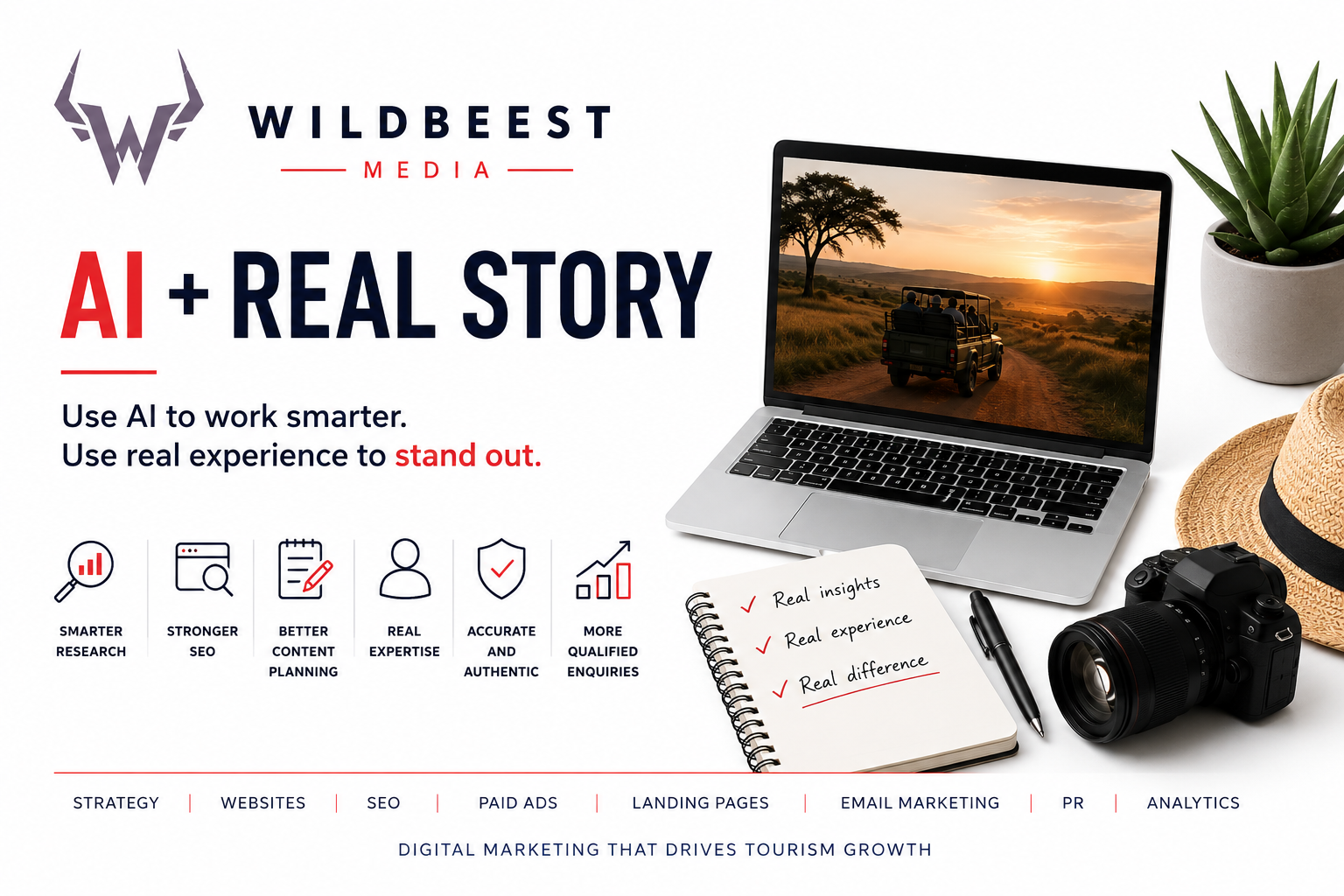
AI and tourism marketing can work well together when AI is used to improve research, planning, SEO and content production without replacing the real knowledge behind the brand. At
WildBeest Media, we use AI as part of a broader
tourism digital marketing strategy that still depends on strong positioning, destination knowledge, useful content and a clear route from discovery to enquiry.
Key Takeaways
- AI can support research, SEO, content planning, campaign development and data analysis.
- AI should strengthen strategy, not replace it.
- Tourism businesses still need real destination knowledge, operational detail and customer understanding.
- Generic AI content can make travel brands sound more alike.
- Tourism SEO benefits from useful, specific and credible content rather than high publishing volume.
- AI works best when it is connected to the wider customer journey, including websites, landing pages, ads and follow-up.
- Human review remains essential for accuracy, relevance and brand positioning.
Where AI Fits into Tourism Marketing
AI tourism marketing is already changing how tourism businesses research audiences, plan content, analyse competitors and manage large amounts of information. Used properly, it can make marketing teams more efficient and help them identify useful patterns faster.
For tourism businesses, AI can assist with customer research, competitor analysis, keyword grouping, content planning, campaign ideas, advertising variations, email planning, website audits and reporting. It can also help organise large amounts of information from reviews, enquiries, surveys and existing website content.
The value comes from using AI to support better decisions. It should not become the decision-maker.
A tool may identify recurring themes across guest reviews, but the business still needs to decide whether those themes matter commercially. It may identify a keyword opportunity, but the marketer still needs to decide whether that search is relevant to the business. It may generate a first draft, but somebody with real product knowledge still needs to determine whether the content is accurate and useful.
This is where AI for tourism businesses becomes practical. It can reduce time spent on repetitive analysis and initial drafting while leaving strategy, positioning and quality control in human hands.
Why AI Should Support Strategy, Not Replace It
One of the main risks with AI is that it makes marketing activity easier to produce without necessarily making the marketing itself better.
A tourism business can now create more articles, more social posts, more ads and more emails in less time. That sounds useful, but volume alone does not improve performance if the business has no clear audience, offer or campaign objective.
A proper tourism digital marketing strategy still needs to answer who the business is trying to reach, what that audience wants, what product or offer is being promoted, why the business is relevant and what the traveller should do next.
AI can support that process by helping analyse information and test ideas, but it cannot remove the need for strategy.
This matters particularly in tourism because travel decisions are often complex. A traveller may be comparing destinations, budgets, dates, flights, room types, guiding options and several operators before they enquire.
The marketing therefore needs to understand that decision process. Generic content around broad terms such as “luxury safari” or “African adventure” does little to help a traveller make a decision.
WildBeest Media approaches AI as one part of a wider marketing system that includes tourism website design, SEO, paid advertising, landing pages, email and conversion tracking. The technology supports the system; it does not replace it.
How AI Can Help with Research, SEO, and Content Planning
This is where AI can provide some of the strongest practical value to tourism businesses.
Customer Research
Tourism businesses often have valuable customer insight spread across emails, enquiry forms, reviews, WhatsApp conversations, surveys and sales notes. AI can help organise that information and identify recurring questions, concerns and buying signals.
A safari business may find that travellers repeatedly ask about malaria, transfers, family suitability, the best travel season or how many nights they should spend in a destination.
Those questions can influence far more than customer service. They can become SEO articles, landing-page content, email topics, FAQs and campaign messaging.
AI helps identify the pattern. The tourism marketer decides how to use it.
Competitor Research
AI can also assist with competitor research by comparing websites, products, positioning, calls to action and content themes.
The objective should not be to copy competitors. It should be to understand how the market is communicating and identify where the tourism business has a stronger or more specific story.
If every lodge in a region uses the same language about “luxury”, “tranquillity” and “unforgettable wildlife”, repeating those phrases with AI-generated variations adds very little value.
A stronger approach is to identify what the business genuinely does differently and build the marketing around that.
Tourism SEO
AI can make parts of tourism SEO faster, particularly when grouping keywords, analysing search intent and finding gaps in existing website content.
However, keyword discovery is only the beginning.
Before publishing an article, the business should ask whether the search is relevant, whether the reader matches the target market and whether the business has useful expertise to contribute.
A tourism company specialising in private safaris may benefit from content around safari length, transfers, family travel, destination combinations and itinerary planning. It is less useful to publish broad travel content simply because a tool shows high search volume.
This is why a strong travel content strategy should be based on commercial relevance and genuine expertise, not only keyword volume.
Content Planning
AI can help organise content around the different stages of the customer journey.
Early-stage content may answer questions such as where to travel, when to go or which destination suits a particular traveller. Mid-stage content can compare experiences, destinations or travel styles. Commercial content can then focus on specific itineraries, departures, packages, offers or enquiry pages.
This structure gives tourism businesses a better chance of supporting the traveller from research to enquiry instead of publishing disconnected articles.
Why Human Story Still Matters in Tourism
Tourism is built on real places, real people and real experiences. That makes human knowledge particularly important.
Travellers want to understand what an experience is actually like, who will look after them, what makes one product different and whether it suits their needs.
Those answers often come from details that AI does not know unless the business provides them.
A guide may know which part of a reserve is more productive at a certain time of year. A lodge manager may know which room configuration works best for families. A photographic host may know why two guests per vehicle changes the experience. A DMC may know that a transfer which appears straightforward on a map is not practical during a certain season.
These details create useful content because they come from real operational experience.
If a tourism business asks AI to “write about our luxury lodge” without supplying any real information, the result will usually rely on common travel language. That is how brands begin to sound interchangeable.
The better approach is to start with the information only the business knows and use AI to help structure, refine or communicate it more effectively.
That is how tourism businesses can use AI without losing their real story.
AI Does Not Fix a Weak Customer Journey
AI can improve content, but it cannot repair a poorly structured marketing journey on its own.
A business can improve an ad and still send visitors to the wrong page. It can publish a strong SEO article without giving the reader a useful next step. It can create email content while the website enquiry process remains confusing.
The full journey still matters.
For paid advertising, this is why landing pages for tourism ads are important. The page needs to continue the same message that attracted the click and guide the traveller towards the next relevant action.
A simple tourism lead-generation journey may look like this:
Search or Advert → Website or Landing Page → Lead → Follow-Up → Enquiry → Booking
AI can support parts of this process, but it cannot compensate for gaps between them.
How Tourism Brands Can Use AI Responsibly
Tourism businesses do not need to avoid AI. They need to use it with clear controls.
Verify the Information
Dates, prices, travel regulations, park rules, transfer details, locations and inclusions should always be checked against reliable information before publication.
AI can produce confident-sounding errors, and tourism businesses cannot afford to publish inaccurate travel advice.
Use Real Source Material
The strongest AI-assisted content starts with genuine business information.
That can include product details, guide notes, guest questions, itineraries, interviews, operational information, customer research and destination knowledge.
The better the source material, the more useful the final output becomes.
Do Not Manufacture Expertise
AI should not be used to create knowledge the business does not actually have.
Tourism brands should not invent reviews, guest stories, sightings, awards, destination experience or staff credentials.
AI can help communicate expertise, but it should not be used to fabricate it.
Keep Human Editorial Control
AI-generated content should be reviewed by somebody who understands the business and the destination.
That review should check accuracy, relevance, brand voice, duplication, search intent and commercial purpose.
The question is not whether the writing sounds polished. The question is whether it is true, useful and relevant to the traveller.
Avoid Publishing for Volume
AI has made it much easier to produce large amounts of content.
That does not mean tourism businesses should publish hundreds of pages simply because they can.
Tourism SEO is better served by useful, well-structured content built around real expertise and relevant search intent than by a large volume of repetitive material.
AI Is Changing Search, but Expertise Still Matters
Search behaviour is changing as travellers use more detailed queries and AI-powered tools to compare destinations, experiences and travel options.
That increases the importance of clear, specific content.
A tourism website should make it easy to understand what the business does, where it operates, who its products suit, what makes them different and how someone can take the next step.
This is useful for travellers, traditional search engines and AI systems trying to identify credible sources.
Generic marketing language provides little evidence of expertise. Detailed, accurate and well-connected content provides much stronger signals.
That is why WildBeest Media builds tourism websites and campaigns around more than visual design. The website, SEO strategy, content, landing pages and supporting marketing need to make the business clear to both people and search systems.
How WildBeest Media Uses AI in Tourism Marketing
WildBeest Media works specifically with tourism businesses, so AI is used within an industry-specific marketing process rather than as a replacement for it.
Our work can include customer and competitor research, traveller personas, campaign planning, tourism SEO, website content, paid advertising, landing pages, lead generation, email marketing, digital PR, website development and performance tracking.
AI can make parts of that process faster and more efficient, particularly where large amounts of information need to be analysed or structured.
The objective remains the same: understand the traveller, build the right offer, communicate it clearly and create a route from discovery to enquiry.
That is what effective tourism marketing needs to do, regardless of the technology involved.
Use AI to Strengthen the Strategy
AI can help tourism businesses research faster, plan better content and make marketing teams more efficient. It works best when it supports real destination knowledge, strong positioning and a clear tourism digital marketing strategy.
WildBeest Media combines tourism expertise, strategy, technology and AI to build marketing around the full journey from discovery to enquiry.
Want to use AI properly in your tourism marketing? Speak to WildBeest Media about a strategy-first approach.
Frequently Asked Questions
Can AI help tourism businesses with marketing?
Yes. AI can support research, SEO planning, content development, competitor analysis, campaign planning, advertising variations and data analysis. It is most effective when used within a clear tourism marketing strategy rather than as a replacement for one.
Should tourism brands use AI for content?
Yes, provided the content is based on real business knowledge and reviewed by someone who understands the product. AI can help with structure and development, but the destination knowledge, operational details and experience should come from the tourism business itself.
Will AI replace tourism marketers?
AI is more likely to change how tourism marketers work than replace the need for them. Strategy, customer understanding, positioning, commercial decisions and brand judgement still require human input.
How does AI affect SEO for tourism?
AI can make SEO research and content production faster, but it also makes generic content easier to create. Tourism businesses therefore need useful, specific and credible content that demonstrates genuine expertise rather than simply increasing publishing volume.
How can tourism businesses keep their content authentic?
Start with real information from the business. Use staff knowledge, guest questions, real itineraries, destination expertise and operational detail. AI can then help organise and communicate that information without replacing the source of the story.
No obligations - just honest advice to cut through the BS.
Feeling Overwhelmed?
Let's Work Together
Downloads
Share The Tips