Struggling with Digital Marketing for your Tourism Business?
How to Choose a Tourism Marketing Agency for Your Lodge, Tour Company, or Travel Brand
Choosing a tourism marketing agency should come down to one question: does the agency understand how tourism businesses attract, influence and convert travellers? A strong
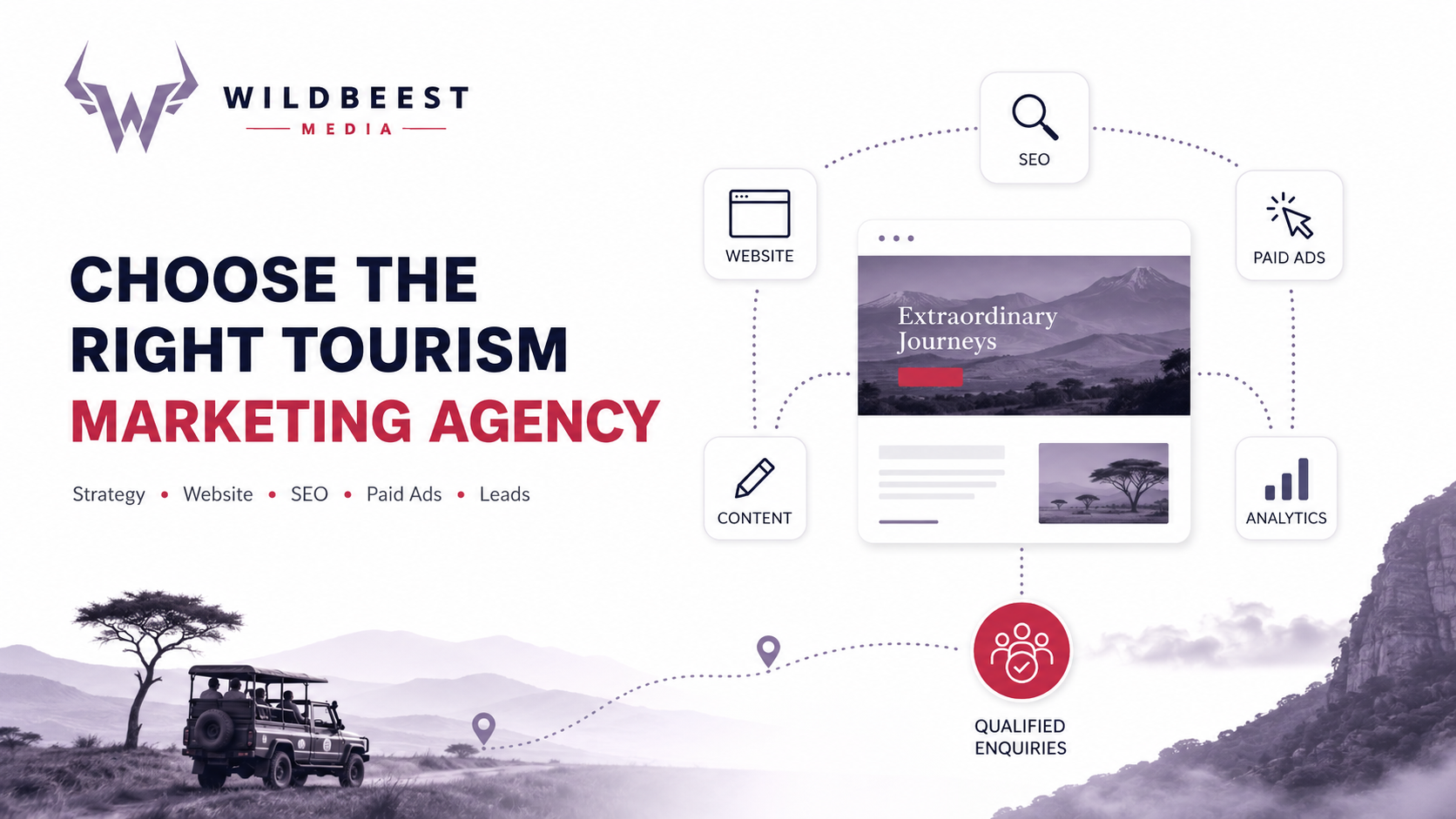
tourism marketing agency should connect strategy,
website performance, SEO, paid advertising, content and lead generation into one measurable system. At
WildBeest Media, that is the approach we take, and tourism businesses can
book a free audit before deciding whether the fit is right.
Key Takeaways
- Choose an agency that understands tourism buying behaviour, not just digital channels.
- Look for a connected approach across strategy, website, SEO, paid ads, content and lead generation.
- Measure performance through qualified enquiries, conversion and revenue, not only reach and clicks.
- Industry knowledge matters because lodges, tour operators and travel brands sell in very different ways from generic service businesses.
Why Tourism Businesses Should Avoid Generic Marketing Agencies
A generic agency may understand digital marketing, but that does not automatically mean it understands tourism.
Tourism is a high-consideration purchase. Travellers often compare destinations, room types, itineraries, inclusions, flights, transfers, seasonality, reviews and pricing before they enquire. For premium international travel, that decision can take weeks or months and may involve several people.
That changes how marketing needs to work.
A marketing agency for lodges should understand occupancy, seasonality, direct bookings, trade relationships, room categories, packages and destination positioning. A marketing agency for tour operators should understand itineraries, departures, source markets, lead times, enquiry quality and how travellers compare several operators before making contact.
The issue is not whether an agency can run Google Ads or publish social media content. The issue is whether it understands what the traveller needs to know before a click can become an enquiry.
A specialist digital marketing agency for tourism should also understand that the customer journey is rarely linear. A traveller may discover a business through Google, return through social media, read a review, compare several websites, see a press article and only enquire weeks later.
That is why tourism businesses should be cautious about choosing an agency purely on design quality, social output or promises of increased visibility. Visibility matters, but it only becomes commercially useful when it contributes to the right enquiries.
What a Specialist Tourism Marketing Agency Should Understand
A specialist agency should understand both tourism marketing and the operational realities behind the product.
It should understand how travellers search, what questions influence a booking, how seasonality affects demand, how direct and trade business interact and how the sales process works after an enquiry arrives.
Traveller search behaviour is particularly important. People search for practical answers such as when to visit, where to stay, which destination to choose, how many nights they need, what a trip costs, whether children can join, what is included and how one experience compares with another.
A good tourism SEO strategy should therefore be built around real traveller intent rather than broad keywords alone.
The agency should also understand long booking cycles. Premium travel is rarely an impulse purchase, so marketing performance cannot always be judged by last-click attribution. Search, content, paid ads, social media, email, reviews and digital PR can all contribute at different stages of the decision.
Direct and trade business also require different thinking. A lodge may want to increase direct enquiries while maintaining strong agent relationships. A DMC may need separate messaging and sales journeys for consumers and trade buyers. A specialist agency should recognise those differences before campaigns are built.
Seasonality and inventory matter too. Tourism marketing should support products that the business actually needs to sell, whether that means a quieter travel period, a specific departure, a priority room type or a new itinerary.
Finally, the agency should understand lead quality. Fifty enquiries are not automatically better than ten if most of those leads have the wrong budget, dates or expectations. For premium tourism businesses, qualified enquiries usually matter more than raw lead volume.
Questions to Ask Before Hiring an Agency
Before appointing a tourism marketing agency, ask questions that reveal how the agency thinks rather than simply what services it sells.
Start with the audience. Ask how the agency will define your target traveller. A useful answer should go beyond age, location and income and consider travel intent, booking window, interests, budget, objections and stage of the buying journey.
Then ask how marketing will connect to enquiries. The agency should be able to explain what happens between an advert, search result or article and the final enquiry, including the website, landing page, call to action, tracking and follow-up process.
Measurement is equally important. Reach, engagement, impressions and website traffic can be useful indicators, but they are not enough on their own. A tourism campaign should also be tracking qualified enquiries, cost per lead, conversion rate, proposal requests, booking value, revenue and return on advertising spend.
Ask how SEO supports commercial growth. SEO should not be presented as a monthly checklist of technical tasks and articles. The agency should explain how search intent, website structure, content, authority and technical performance support the products and markets the business wants to grow.
The same applies to paid ads. An agency should not discuss Google Ads or Meta Ads without discussing where that traffic lands. If a campaign promotes a specific package or offer, the website experience should continue the same message.
It is also worth asking what happens when the data shows the original strategy is not working. A competent agency should be willing to adjust audiences, offers, pages, messaging or channel allocation rather than defend a plan simply because it was proposed at the start.
How to Compare Strategy, Website, SEO, and Paid Ads Support
When comparing agencies, look at how well they connect the full marketing system.
The strategy should come first. Before execution begins, the agency should understand the commercial objective, priority audience, offer, message, conversion action and measurement framework. A proposal that begins with posting frequency or ad volume before discussing the business objective is usually too channel-led.
The website is also critical. It should support search visibility, traveller research, trust and conversion. A strong tourism website should make it easy to understand what the business offers, where it operates, who the product suits, what makes it different and how to take the next step. That is why website strategy is central to the work of a specialist tourism web design agency.
SEO should be based on real search behaviour. Informational searches such as “best time to visit Kruger” play a different role from commercial searches such as “private Kruger safari package”. Both can be valuable, but they serve different stages of the customer journey and should not be treated as the same opportunity.
Paid advertising should also have a defined role. Google Ads can capture existing search demand, while Meta Ads can help create awareness, promote offers and retarget travellers who have already shown interest. The agency should understand when to use each channel and how the traffic will move towards an enquiry.
Specific campaigns may also require specific landing pages. A general homepage can be too broad when a traveller clicked an advert for one particular offer. The page should continue that offer clearly and give the visitor a direct next step.
Content and digital Press Release should support the same system. Website articles, destination content, campaign pages, FAQs and external publishing can all strengthen search visibility and authority when they are built around genuine expertise and clear commercial relevance.
WildBeest Media also uses VoyaPress as part of this wider ecosystem, giving tourism and hospitality businesses a dedicated platform for publishing relevant news, announcements and industry stories. Businesses can review how VoyaPress works to understand how tourism-focused publishing can support broader visibility, digital PR and authority-building.
The objective is not to publish more content simply to create activity. Every channel should have a clear role in the wider strategy.
Why WildBeest Media Focuses on the Full Tourism Marketing System
WildBeest Media is a digital marketing agency for tourism businesses, so we do not start with a predetermined channel. We start with the commercial problem.
That problem may be weak direct enquiries, poor lead quality, low organic visibility, underperforming paid campaigns, a website that is not converting, seasonal demand gaps, weak positioning or poor tracking.
The solution depends on the cause.
Our work can include customer and competitor research, tourism marketing strategy, traveller persona development, website development, tourism SEO, content strategy, Google Ads, Meta Ads, landing pages, lead magnets, email marketing, digital Press Release, conversion tracking and performance reporting.
The objective is not to sell every service to every business. It is to combine the services needed to improve the full customer journey.
A better advert will not fix a weak landing page. Better SEO will not compensate for a website that fails to explain the product clearly. More traffic will not help if the enquiry process is poor, and more content will not solve weak positioning.
That is why we focus on how the system works together.
A tourism marketing agency should also be able to explain its work in clear commercial terms. You should understand which audience is being targeted, what is being promoted, what the data shows and what changes are being made as a result.
That level of clarity is more valuable than a long monthly report filled with metrics that do not affect business decisions.
Choose an Agency That Understands the Business Behind the Marketing
The best tourism marketing agency is not necessarily the agency with the longest list of services. It is the agency that understands your product, traveller, market and commercial priorities, and can connect the right channels around those priorities.
At WildBeest Media we work with lodges, tour operators and travel brands that need a more structured approach to marketing and growth.
Looking for a tourism marketing agency that understands your industry?
Frequently Asked Questions
How do I choose a tourism marketing agency?
Choose an agency that understands tourism buying behaviour and can connect strategy, website performance, SEO, paid advertising, content and lead generation. Ask how it measures qualified enquiries, conversion and revenue rather than relying only on traffic and engagement metrics.
Why use a specialist tourism marketing agency?
A specialist tourism marketing agency understands factors such as seasonality, source markets, direct versus trade business, long booking cycles, destination search behaviour and high-value enquiry processes. That industry knowledge allows strategy and execution to be more commercially relevant.
What should a tourism marketing agency offer?
The exact service mix depends on the business, but a strong agency should be able to support strategy, research, website performance, SEO, paid advertising, content, landing pages, lead generation, tracking and reporting. The important point is that those services should work together.
Should my agency understand booking systems?
Yes. The agency does not need to operate every booking platform, but it should understand how the website, booking engine, enquiry form, CRM or reservation workflow affects conversion and tracking.
What makes WildBeest Media different?
WildBeest Media focuses specifically on tourism businesses and approaches marketing as one connected system. We combine tourism strategy, websites, SEO, paid advertising, content, landing pages, lead generation, digital PR and tracking around a defined commercial objective instead of treating each channel as an isolated service.
No obligations - just honest advice to cut through the BS.
Feeling Overwhelmed?
Let's Work Together
Downloads
Share The Tips