Struggling with Digital Marketing for your Tourism Business?
SEO vs Paid Ads for Tourism: Which One Should Your Business Focus On First?
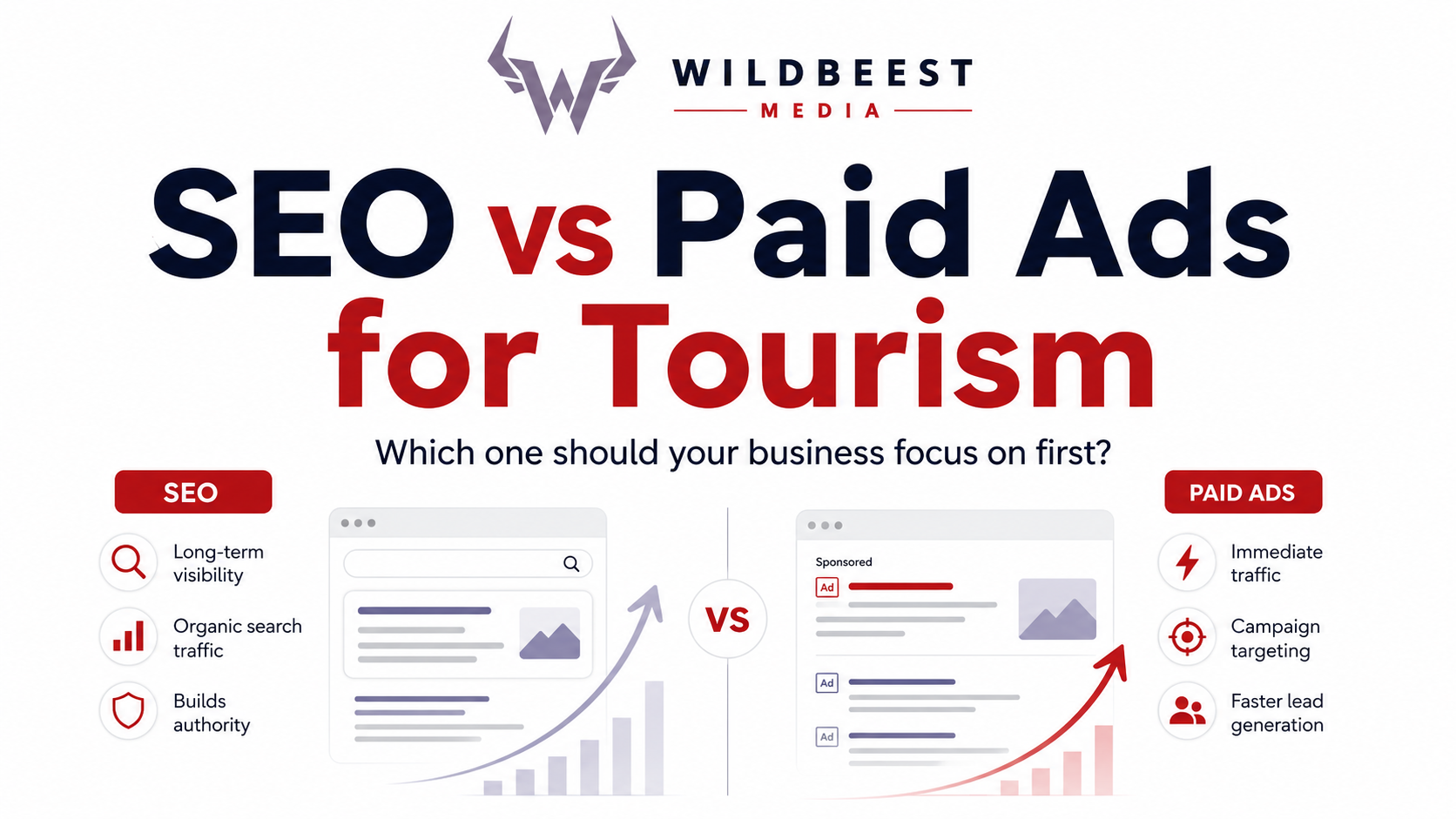
For most tourism businesses, paid ads should come first when immediate enquiries are the priority, while Tourism SEO should come first when the goal is long-term search visibility. The strongest strategy usually combines both: paid ads generate demand now, while SEO builds sustainable growth over time.
At
WildBeest Media, we build
digital marketing for tourism businesses around connected
tourism marketing services, not isolated tactics. If you are unsure which channel deserves your first investment,
book a free strategy call and we will assess your offer, website, market and current lead flow.
Key Takeaways
- Paid ads are best when your tourism business needs traffic, enquiries or campaign data quickly.
- Tourism SEO is better for building long-term visibility and reducing dependence on continuous advertising.
- Neither SEO nor paid ads will perform properly without a clear offer, strong website and simple enquiry process.
- Paid ads and SEO work best together, with ads driving immediate demand while SEO builds long-term growth.
- The right starting point depends on your current business goals, budget, visibility and urgency.
The Difference Between SEO and Paid Ads
Tourism SEO helps your website appear in unpaid search results when travellers search for accommodation, destinations, tours, activities and travel advice.
Paid advertising places your business in front of selected audiences through platforms such as Google Ads and Meta Ads.
The biggest difference is speed.
Paid ads can begin generating traffic as soon as the campaign is running. SEO takes longer because your website must build relevance, authority and trust around the searches you want to target.
The second difference is durability.
Paid traffic usually stops when the advertising budget stops. Strong SEO pages can continue attracting relevant visitors long after they are published, provided they remain useful, competitive and technically sound.
| Factor | Tourism SEO | Paid Ads for Tourism |
|---|---|---|
| Speed | Builds visibility gradually over time | Can generate traffic as soon as the campaign launches |
| Cost model | Investment in SEO strategy, content and website optimisation | Advertising budget for clicks, impressions or leads, plus campaign management |
| Longevity | Can continue generating traffic and enquiries over time | Traffic usually stops when the advertising budget stops |
| Targeting | Reaches people searching for relevant destinations, experiences and travel information | Targets people by keywords, location, interests and online behaviour |
| Best use | Building long-term visibility, authority and direct enquiries | Generating immediate demand, promoting offers and testing new markets |
| Main risk | Expecting results before the strategy has had time to work | Paying for traffic that does not convert into enquiries |
SEO is not free traffic. It requires research, writing, technical improvements, website development, authority building and regular optimisation.
Paid advertising is not guaranteed traffic either. You can buy clicks. You cannot buy a good offer, a credible website or a working enquiry process.
That is why the SEO vs paid ads decision cannot be made by looking only at traffic. It must be based on what your tourism business needs to achieve.
When Tourism Businesses Should Start with SEO
Tourism businesses should prioritise SEO when they have a stable product, a functional website and enough time to build long-term search visibility.
This is often the correct starting point for established lodges, tour operators, activity providers, destination businesses and travel companies that are operating consistently but are difficult to find online.
Tourism SEO should become a priority when:
- Travellers are already searching for the destinations or experiences you sell.
- Competitors consistently appear above your business in Google.
- Your website has very little useful destination or product content.
- You depend heavily on OTAs, agents or third-party booking platforms.
- Your tours, accommodation or experiences are available throughout the year.
- You want to increase direct enquiries over the next six to twelve months.
- You already receive website traffic but need stronger commercial visibility.
A lodge near Kruger National Park, for example, should not only try to rank for its business name. It should build visibility around the searches travellers use before they know which lodge they want.
These searches could include:
- Safari lodges near Kruger National Park
- Where to stay near Hoedspruit
- Family safari accommodation in Greater Kruger
- Private safari lodge with game drives
- SADC resident safari specials
- Luxury safari packages in South Africa
The same principle applies to tour operators and travel companies. Your potential customer may begin with a destination, activity, route, travel concern or type of experience rather than your company name.
Start with the Pages That Can Generate Business
Many tourism businesses treat blogging as their entire SEO strategy. It is not.
Your first SEO priority should be the pages closest to an enquiry or booking:
- Accommodation pages
- Tour and itinerary pages
- Experience pages
- Destination pages
- Rates and special-offer pages
- About and trust pages
- Contact and enquiry pages
Informational articles then support these commercial pages by answering the questions travellers ask during the research and comparison stages.
A blog about the best time to visit a destination should lead readers towards the relevant tour, lodge, itinerary or enquiry page. Otherwise, you may gain traffic without creating a clear route towards a sale.
Tourism SEO Also Happens Outside Your Website
Google and potential customers should be able to find credible information about your business beyond your own website.
This can include destination directories, tourism associations, partner websites, interviews, media coverage and relevant press releases.
Tourism businesses can use VoyaPress to publish credible announcements about new products, seasonal offers, trade partnerships, conservation projects, new routes, property developments and other legitimate business news.
Businesses with a relevant announcement can also submit a tourism press release for free.
External publishing does not replace your on-site Tourism SEO. It supports it by expanding your online footprint, creating additional discovery paths and giving travellers more context about your business.
When Paid Ads Make More Sense
Paid ads for tourism make more sense when the business needs immediate traffic, faster market feedback or enquiries for a specific offer.
This does not mean that paid advertising will produce instant profitability. It means you can begin reaching selected audiences without waiting for your website to earn stronger organic rankings.
Paid advertising should receive priority when:
- You have launched a new tourism business or product.
- Your website has little existing search visibility.
- You need to fill specific travel dates or available rooms.
- You are promoting a seasonal offer.
- You want to test a new market or customer segment.
- You are entering a new destination or source market.
- You need data before committing to a larger content strategy.
- You have a strong offer and landing page ready to convert traffic.
Google Ads Capture Existing Demand
Google Ads are useful when travellers are actively searching for something you sell.
A traveller searching for “luxury safari lodge in Botswana,” “family holiday in Mauritius,” “guided Kilimanjaro trek” or “airport transfers in Cape Town” is already showing commercial intent.
Your advertisement can place the correct offer in front of that traveller immediately.
However, the campaign must match the search.
Do not send every visitor to your homepage. A search for a family safari should lead to a family-focused safari page. A search for an island honeymoon should lead to the relevant accommodation or package page. A search for an airport transfer should lead directly to the transfer service.
The closer the landing page matches the traveller’s search, destination and intent, the easier it becomes for them to understand the offer and take the next step.
Meta Ads Can Create and Redirect Demand
Meta Ads work differently.
People scrolling through Facebook or Instagram may not currently be searching for your lodge, tour or destination. The campaign must create enough interest to interrupt them.
This makes Meta useful for:
- Introducing distinctive tourism experiences
- Promoting visual travel products
- Building remarketing audiences
- Advertising lead magnets
- Collecting email subscribers
- Promoting limited travel dates
- Reaching previous website visitors
- Re-engaging people who viewed an offer but did not enquire
Meta Ads should not be treated as boosted social media posts. A proper campaign needs a defined audience, clear offer, strong creative, relevant landing page, tracking and a follow-up process.
Do Not Advertise a Weak Offer
Paid traffic exposes problems quickly.
If the offer is unclear, the website is slow, the rates are hidden, the images are weak or the enquiry form is difficult to use, advertising will not fix the problem. It will simply send more people into a poor customer journey.
Before spending on paid ads for tourism, confirm that you have:
- A specific product or offer
- A defined target traveller
- A dedicated landing page
- A clear price or value proposition
- Strong trust signals
- Mobile-friendly website performance
- A simple enquiry or booking process
- Conversion tracking
- A system for responding to leads quickly
Traffic is not the objective. Qualified enquiries and profitable bookings are.
Why SEO and Paid Ads Work Better Together
SEO vs paid ads should not become a permanent either-or decision.
The strongest tourism marketing strategy uses paid advertising to create immediate movement while SEO builds the long-term foundation.
Paid campaigns can show you:
- Which destinations attract the most attention
- Which offers generate enquiries
- Which keywords produce stronger leads
- Which markets respond to your pricing
- Which landing-page messages convert
- Which traveller segments are worth developing
That information can then improve your Tourism SEO.
If a Google Ads campaign shows that “private family safari Greater Kruger” produces qualified enquiries, the business can build stronger organic content around family safaris, Greater Kruger planning and private safari experiences.
SEO also improves paid campaign performance.
A traveller may first see an advertisement, leave the website and search for the business later. Strong search visibility, useful content, press coverage and well-structured product pages help that traveller confirm that the business is credible.
A connected travel business marketing system might look like this:
Traveller sees an advertisement → visits a landing page → reads supporting content → leaves the website → searches for the business → finds additional proof → joins the email list or submits an enquiry → receives follow-up → confirms a booking.
Very few travel purchases happen after one click.
Tourism products often involve significant costs, travel logistics, multiple decision-makers and long planning periods. Your marketing must support the full decision process, not only the first website visit.
How to Build a Balanced Tourism Marketing Strategy
There is no universal percentage that every tourism business should spend on SEO and paid advertising.
The correct balance depends on your current visibility, available budget, booking window, seasonality, competition, product value and growth targets.
1. Fix the Foundation First
Before choosing between SEO and paid ads, review:
- Your positioning
- Your target audience
- Your core offers
- Your website structure
- Your landing pages
- Your enquiry process
- Your booking integrations
- Your analytics and conversion tracking
Sometimes the correct first investment is neither SEO nor advertising.
If the website does not explain what you sell, who it is for and why someone should choose it, driving more traffic will not solve the problem.
2. Separate Immediate Demand from Long-Term Growth
Decide what must happen now and what must be built over time.
Paid advertising can support immediate priorities such as:
- Filling low-occupancy dates
- Launching a new itinerary
- Promoting a limited offer
- Testing a new source market
- Generating leads for a specific product
Tourism SEO should support longer-term priorities such as:
- Becoming visible for destination searches
- Building authority around specialist experiences
- Increasing direct website discovery
- Reducing dependence on third-party platforms
- Creating a sustainable content and visibility system
3. Match the Strategy to the Business Stage
| Business situation | Recommended priority |
|---|---|
| New business with no search visibility | Paid ads while building the SEO foundation |
| Established business that is difficult to find | Tourism SEO supported by targeted paid campaigns |
| Urgent occupancy or departure-date gaps | Paid ads |
| Website receives traffic but few enquiries | Conversion improvements before increasing traffic |
| Strong seasonal product | Paid campaigns around booking windows and SEO for recurring searches |
| Heavy dependence on OTAs | SEO, direct-booking pages and brand-search campaigns |
| New product with uncertain demand | Paid testing before committing to large-scale content production |
| Strong organic visibility but slow periods | Paid advertising for tactical demand generation |
4. Build Campaigns Around Offers, Not Channels
Do not run an SEO strategy, Google Ads strategy, Meta strategy and email strategy as four unrelated projects.
Build one campaign around a commercial objective.
For example:
Objective: Generate more direct enquiries for three-night safari getaways.
The campaign could include:
- A dedicated getaway landing page
- Google Ads targeting high-intent getaway searches
- Meta Ads introducing the experience
- SEO articles supporting destination and planning searches
- A press release announcing the new getaway collection
- Remarketing advertisements
- An email campaign
- Enquiry and booking tracking
Each channel has a different job, but they all feed the same commercial objective.
5. Measure Business Results
Do not judge your tourism marketing strategy using only clicks, impressions, followers or website sessions.
Measure:
- Qualified enquiries
- Cost per qualified enquiry
- Landing-page conversion rate
- Direct booking value
- Organic visibility for commercial searches
- Enquiry-to-booking conversion rate
- Revenue influenced by each campaign
- Assisted conversions across multiple channels
- Source-market performance
- Offer-level profitability
Marketing activity is easy to produce. A connected growth system is harder, but it is what generates meaningful results.
Not Sure Where to Spend First?
Do not choose a channel because it is fashionable, familiar or easy to launch.
Choose it because it solves the next commercial problem in your business.
Book a free strategy call and we will help you prioritise your Tourism SEO, paid advertising, website, landing pages and wider tourism marketing strategy.
We will review your current visibility, offer, customer journey, conversion gaps and immediate growth targets—then identify what should happen first.
Frequently Asked Questions
Is SEO or paid advertising better for tourism?
Neither is automatically better. Paid advertising is stronger for immediate traffic, offer testing and time-sensitive campaigns. Tourism SEO is stronger for long-term search visibility and reducing dependence on continuous advertising. Most established tourism businesses need both, introduced in the correct order.
Should lodges invest in SEO or Google Ads first?
A lodge that needs to fill rooms quickly should usually prioritise targeted Google Ads, provided it has a strong offer and conversion-focused landing page. A lodge with stable occupancy goals but weak organic visibility should invest in SEO. Before investing in either, the lodge must have clear rates, strong property pages and a simple booking or enquiry process.
How long does Tourism SEO take?
There is no fixed timeline. A technically sound website with existing authority may show progress within a few months. A new website in a competitive destination may require six months or longer before producing substantial commercial visibility. SEO should be treated as an ongoing business asset rather than a once-off campaign
How quickly can paid ads generate enquiries?
Paid campaigns can begin generating website visits as soon as they are approved and activated. Qualified enquiries may arrive within days when the targeting, offer, landing page and follow-up process are aligned. Early enquiries do not automatically prove that the campaign is profitable, so campaigns must be tracked and refined.
Can SEO and paid ads work together?
Yes. Paid ads can generate immediate traffic and reveal which offers, audiences and keywords produce enquiries. SEO can then build long-term visibility around those findings. Organic content also gives travellers additional information and proof after they encounter an advertisement.
No obligations - just honest advice to cut through the BS.
Feeling Overwhelmed?
Let's Work Together
Downloads
Share The Tips