Struggling with Digital Marketing for your Tourism Business?
How AI Can Improve Market Research for Tourism Businesses
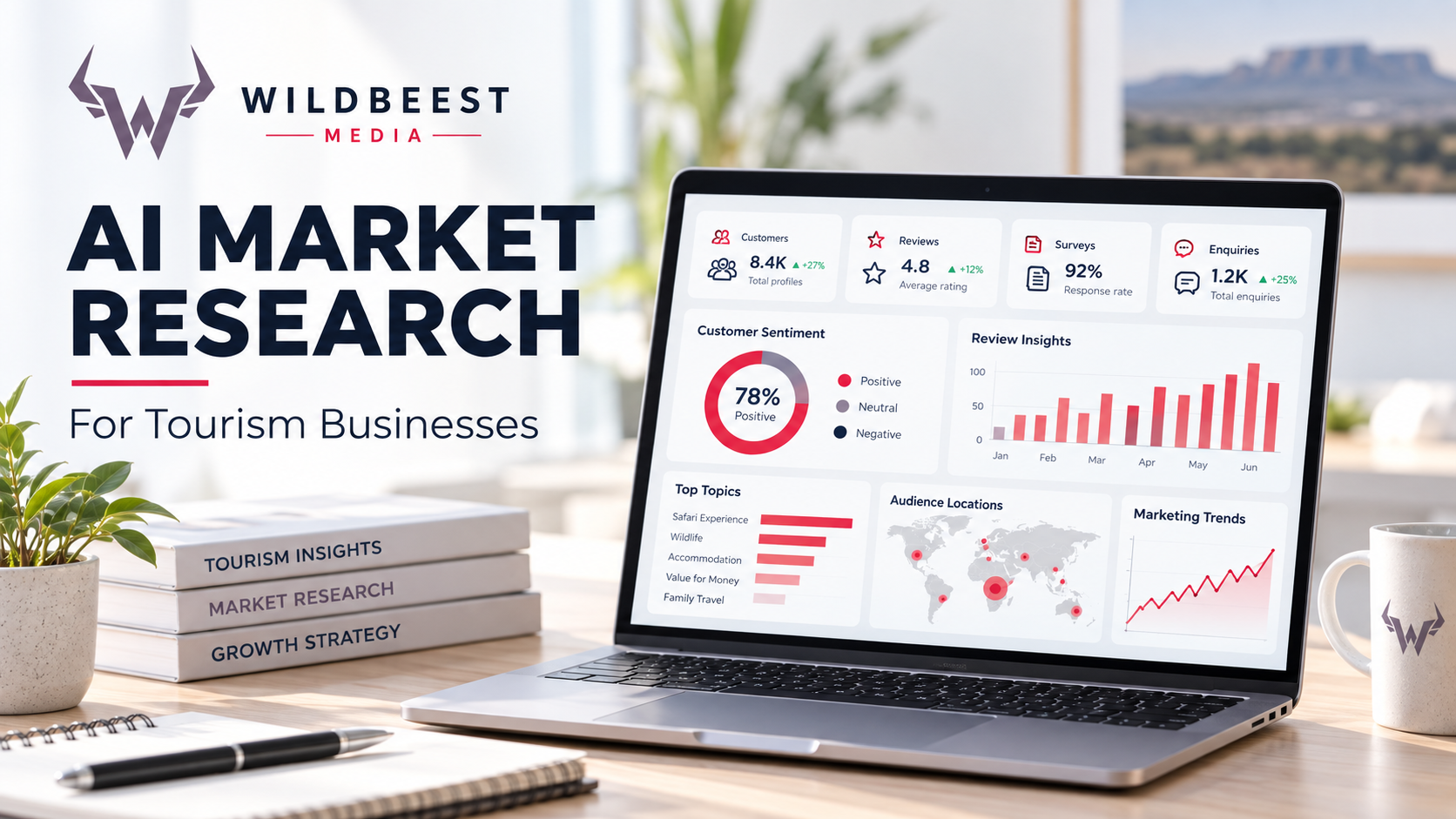
AI can improve market research by helping tourism businesses organise customer information, identify recurring questions and compare patterns across reviews, surveys and enquiries. At
WildBeest Media, we use AI within a broader
tourism digital marketing process, while our
three-month growth strategy turns those insights into practical campaigns rather than research that sits in a report.
Key Takeaways
- AI market research works best when it analyses real customer information rather than inventing audience personas.
- Reviews, surveys and enquiries can reveal recurring questions, booking barriers, motivations and information gaps.
- AI can make qualitative research faster, but its findings still need to be checked against the original data.
- The value of AI customer insights comes from what the business does with them across its website, SEO, advertising, email and sales process.
Using AI for Market Research and Customer Insights
Traditional market research can involve reviewing large amounts of information before useful patterns begin to emerge. AI can reduce some of that manual work by helping businesses organise, compare and summarise information that already exists.
For tourism businesses, useful research material is often spread across several places. Enquiry emails may reveal questions travellers repeatedly ask before booking. Reviews may explain which parts of an experience guests valued after travelling. Website search data can show what people are researching, while surveys may reveal why customers chose one product over another.
AI for market research can help bring those signals together.
The important distinction is between analysing evidence and generating assumptions. Asking an AI tool to “create a customer persona for a safari lodge” may produce a plausible profile, but plausible is not the same as researched. The result is based on patterns the model knows rather than evidence from that specific business.
A stronger process starts with actual information. A tourism business might provide a set of enquiry emails and ask AI to group the questions by theme, or analyse customer feedback to identify issues that appear repeatedly. Those findings can then be compared with website content, advertising messages or the booking process.
This is where AI customer research becomes commercially useful. The objective is not to produce a document describing an imaginary traveller. It is to understand the questions, concerns and motivations that appear in real customer behaviour.
The same principle applies when selecting the technology. As we explained in our previous article on the best AI marketing tools for tourism businesses, the tool should be chosen according to the marketing job it needs to perform. AI market research is valuable because it can help process information more efficiently, not simply because the software contains AI.
AI Customer Research Using Reviews, Surveys and Enquiries
Reviews are one of the most useful sources of customer language available to a tourism business because they show what people chose to mention after the experience.
AI can help analyse a body of reviews and group comments around recurring themes. Instead of reading each review independently, a business can look for patterns in the reasons customers were satisfied, the questions they still had, aspects they found confusing and the parts of the experience that received repeated attention.
The same approach can be used with surveys. Open responses can be difficult to analyse when customers use different words to describe similar issues. AI can help classify those responses into broader themes while preserving the underlying comments for human review.
Enquiries provide a different type of insight because they capture the customer before the booking decision. They may reveal uncertainty around the product, information that was difficult to find on the website or practical considerations that influence whether someone proceeds.
For example, rather than asking AI what potential guests might want to know, a tourism business can analyse actual enquiries and ask:
- Which questions occur most frequently?
- What information are potential customers struggling to find?
- Which concerns appear before someone commits?
- What product differences are people comparing?
- Which questions could be answered more clearly on the website?
- Which themes could support future SEO articles or advertising?
The answers can inform several parts of the marketing process. If the same question appears repeatedly in enquiries, it may belong on a product page or FAQ. If reviews consistently mention one aspect of the experience, that may deserve greater prominence in the marketing. If surveys show confusion around a particular part of the offer, the issue may be the way the product is being explained rather than the product itself.
This is considerably stronger than using AI to manufacture customer needs from scratch.
Using AI Sentiment Analysis to Understand Customer Feedback
AI sentiment analysis attempts to interpret the tone or attitude expressed in written feedback. At a basic level, it may classify comments as positive, negative or neutral, but the more useful application is identifying what the sentiment relates to.
A review can be positive overall while still raising an important problem. A customer may praise the experience but mention that the booking process was difficult. Another may be satisfied with the product while indicating that information before arrival was unclear.
Simply assigning a positive score to both comments would miss the useful detail.
For tourism market research, sentiment analysis should therefore be used alongside thematic analysis. The better question is not simply whether customers are happy. It is what are they happy or unhappy about, and does the same issue appear repeatedly?
AI can help separate comments around different parts of the customer journey, such as the initial research process, communication before booking, product expectations and post-experience feedback. This makes large amounts of qualitative information easier to review without reducing every customer comment to a single sentiment label.
Context still matters. Sarcasm, mixed opinions, short reviews and ambiguous language can all affect interpretation. AI-generated classifications should therefore be treated as research assistance rather than an unquestionable measurement of customer sentiment.
The Practical Value of AI Market Research
AI improves tourism market research when it helps a business extract useful patterns from genuine customer and market information faster. The strongest applications include analysing reviews, survey responses and enquiries; identifying recurring questions and booking barriers; grouping customer feedback into themes; and comparing those findings with existing marketing.
The technology does not remove the need for customer research. It makes existing research easier to organise and use. The business still needs to verify the findings, understand the commercial context and decide what action should follow.
Finding Customer Pain Points and Travel Motivations With AI
A useful piece of market research should help explain both why somebody wants the product and what may prevent them from choosing it.
These are different questions.
Travel motivations can include the type of experience someone is looking for, the reason for travelling, the destination they are considering or the way they want to spend their time. Booking barriers are the questions, concerns and uncertainties that may prevent that person from moving forward.
AI customer insights can help identify both when the source material is strong enough.
A tourism business could analyse enquiries from a particular product and look for recurring decision factors. It could compare enquiries that progressed with those that did not, provided there is enough reliable information to make that comparison. It could also examine whether certain questions repeatedly appear before a customer is ready to book.
The objective is not to attach every traveller to a fixed persona. People can have overlapping motivations and may change their priorities as they research a trip.
A better approach is to understand the decisions they are making.
That distinction matters for marketing. Someone searching broadly for ideas may need destination information and inspiration, while somebody comparing two specific products may need practical details that help them choose. Someone who has already submitted an enquiry may need reassurance or clarification rather than another awareness advert.
AI market research can help a business recognise these different stages when it is given real evidence from the customer journey.
Search data can add another layer. Queries from Search Console or specialist SEO platforms can show the language people use when researching a destination, experience or problem. AI can then help group those searches by intent and compare them with the questions appearing in enquiries.
The combination is useful because search behaviour tells you what people ask publicly, while enquiries and surveys reveal what they ask once they are considering the business more seriously.
That can expose useful gaps. A business may discover that customers regularly ask a question that the website barely addresses, or that an important selling point appears repeatedly in reviews but receives little attention in advertising.
Those are actionable AI customer insights.
Turning AI Market Research Into Better Marketing Decisions
Market research has limited value if it does not influence what happens next.
Once recurring themes have been identified, the business needs to decide which findings matter commercially and where they should be addressed. Not every customer comment requires a new campaign, and not every repeated question requires a new website page.
The first step is usually to separate the findings into practical categories.
Questions about the product may require clearer website content. Search themes may support SEO articles. Repeated objections may influence a landing page or paid advertising campaign. Common pre-booking questions may belong in email follow-up. Feedback about how the offer is presented may require changes to the marketing message itself.
This creates a stronger connection between AI market research and the rest of the marketing system.
At WildBeest Media, customer and audience research sits alongside SEO, paid advertising, website content, landing pages, email and campaign strategy. The purpose is not to produce research for its own sake; it is to give each part of the campaign better information to work from.
Research can also prevent unnecessary marketing activity. If the evidence shows that customers already understand one part of the offer but repeatedly struggle with another, the business has a clearer indication of where attention should go.
AI can help speed up that analysis, but the decision still requires context. A recurring question may be commercially important, operationally irrelevant or simply the result of information being difficult to find. The business needs to decide which explanation is most credible before changing its strategy.
The same applies to competitor and market information. AI can assist with organising research, but conclusions should be based on verifiable sources rather than assumptions generated by the model.
Used properly, AI for market research creates a simple progression:
Customer evidence → patterns → marketing insight → business decision → campaign action
That is where the value lies.
Turn Real Customer Data Into a Stronger Tourism Marketing Strategy
AI market research becomes useful when the findings influence the marketing decisions that follow. Reviews, enquiries, surveys and search behaviour can provide a clearer picture of what customers want to know, what affects their decisions and where the marketing is failing to answer them.
At
WildBeest Media, we use customer research as part of a connected tourism marketing system covering SEO, paid advertising, content, websites, landing pages and lead generation. If you want to turn existing customer information into a clearer marketing plan, our
three-month growth strategy is designed to identify those opportunities and build the next campaign around them.
Frequently Asked Questions
Can AI replace traditional customer surveys?
No. AI can help design, organise and analyse survey information, but it does not replace the value of asking real customers questions. The strongest approach is to collect genuine customer feedback and then use AI to help identify patterns across the responses.
Can ChatGPT access current market research data?
ChatGPT can search the web for current information when web search is available, but it should not be assumed to have access to every market research database or proprietary dataset. Current market research should be sourced from appropriate live sources and then analysed in context rather than relying on the model to supply unsupported figures.
How accurate is AI sentiment analysis?
Its usefulness depends on the quality, volume and context of the source material. AI can help identify broad themes and sentiment across customer feedback, but mixed opinions, sarcasm and ambiguous wording can produce misleading classifications. Important findings should therefore be checked against the original comments.
Can AI analyse Google Reviews and TripAdvisor reviews?
AI can analyse review text that a business lawfully has access to and provides for analysis. It can help group comments by theme, identify repeated questions and compare customer language, but the original reviews should remain the source of truth rather than the AI-generated summary.
Can I upload survey results to ChatGPT for analysis?
Yes. ChatGPT currently supports analysis of uploaded spreadsheet and other common data files, which can be used to explore responses, identify patterns and create summaries. Businesses should provide clear context for the data and avoid uploading sensitive information unnecessarily.
No obligations - just honest advice to cut through the BS.
Feeling Overwhelmed?
Let's Work Together
Downloads
Share The Tips